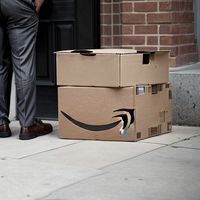
On Wednesday, the Attorney General of Washington, D.C., filed a lawsuit against Amazon, alleging that the corporation has been secretly denying residents of certain ZIP codes in the capital access to the rapid delivery services offered by its Prime membership. The legal action, initiated by Attorney General Brian Schwalb, asserts that since 2022, Amazon has been excluding two "historically underserved" ZIP codes in D.C. from its expedited delivery service, while still charging full subscription fees to Prime members residing in those areas. The annual cost of Amazon's Prime membership is $139, which includes benefits such as two-day shipping and access to streaming services.
"Amazon is charging tens of thousands of hard-working residents of Wards 7 and 8 for an expedited delivery service it promises but fails to deliver," Schwalb stated. "While Amazon has every right to make operational changes, it cannot secretly decide that a dollar in one zip code is worth less than a dollar in another."
In response, Amazon spokesperson Kelly Nantel declared in a statement that it is "absolutely untrue" to suggest that the company's practices are "discriminatory or deceptive." Nantel emphasized, "Our goal is to deliver as quickly as possible to every ZIP code across the nation, but we must prioritize the safety of our delivery drivers above all else." She explained that in the specified ZIP codes, there have been "specific and targeted acts against drivers delivering Amazon packages," leading to a deliberate operational adjustment, including changes to delivery routes and times, solely for the protection of driver safety.
Nantel further mentioned that Amazon has proposed collaborating with the Attorney General's office to "reduce crime and enhance safety in these areas." According to the lawsuit, in June 2022, Amazon ceased using its own delivery trucks for package transportation in ZIP codes 20019 and 20020 due to driver safety concerns. Instead, the company began relying on external carriers such as UPS and the U.S. Postal Service for deliveries. This decision resulted in residents of these areas, which are among the most populous ZIP codes in D.C., experiencing "significantly longer delivery times" compared to their neighbors in other parts of the district, despite paying the same Prime membership fee.
The data presented by the Attorney General indicates that prior to Amazon's policy change, over 72% of Prime packages in the two ZIP codes were delivered within two days of purchase. After the change, this figure plummeted to as low as 24%, while the two-day delivery rate across the district increased to 74%.
Amazon has previously faced allegations of disparities within its Prime program. In 2016, following a Bloomberg investigation that revealed Black residents were "about half as likely" to be eligible for same-day delivery as white residents, the company announced it would expand access to same-day delivery in cities like Atlanta, Chicago, Dallas, and Washington. The ZIP codes highlighted in Schwalb's complaint are predominantly inhabited by Black populations, according to 2022 Census data from the American Community Survey.
The Federal Trade Commission also took legal action against Amazon in June 2023, accusing the company of misleading consumers into signing up for Prime and "undermining" their efforts to cancel through the use of so-called dark patterns, which are deceptive design tactics aimed at guiding users toward a specific choice. Amazon has refuted the complaint as "false in both fact and law," with the trial set for June 2025.
Schwalb's complaint alleges that Amazon never informed Prime members in the affected areas about the delivery exclusion. When consumers in these ZIP codes complained to Amazon about the slower delivery speeds, the company attributed the delays to circumstances beyond its control.
The lawsuit accuses Amazon of violating the district's consumer protection laws and requests the court to "put an end to Amazon's deceptive conduct," as well as to award damages and penalties. Amazon utilizes a combination of its own contracted delivery companies, identifiable by Amazon-branded cargo vans, along with carriers like USPS, UPS, and FedEx, and a network of gig workers who deliver packages from their personal vehicles as part of its Flex program, to ensure packages reach customers' doorsteps.
Amazon has significantly expanded its in-house logistics force in recent years, aiming to accelerate deliveries from two days to one day or even just a few hours. In July, the company reported its "fastest Prime delivery speeds ever," with over 5 billion items delivered within a day.
By relying on its own workforce, Amazon has gained greater control over its delivery operations. Schwalb's complaint references an internal company policy that allows Amazon to opt out of serving certain areas with its in-house delivery network if a driver experiences "violence, intimidation, or harassment," with UPS or USPS then handling deliveries in those areas.

By Sarah Davis/Dec 5, 2024
By Emily Johnson/Dec 5, 2024

By Noah Bell/Dec 5, 2024

By Sarah Davis/Dec 5, 2024
By iuno001/Nov 29, 2024

By iuno001/Nov 29, 2024
By iuno001/Nov 29, 2024

By iuno001/Nov 29, 2024

By iuno001/Nov 29, 2024

By iuno001/Nov 29, 2024

By iuno001/Nov 29, 2024

By iuno001/Nov 29, 2024

By iuno001/Nov 29, 2024

By iuno001/Nov 29, 2024

By iuno001/Nov 29, 2024

By iuno001/Nov 29, 2024

By iuno001/Nov 29, 2024

By iuno001/Nov 29, 2024

By iuno001/Nov 29, 2024

By iuno001/Nov 29, 2024